What we do

What makes us different?

  Holistic and Multi-Dimensional

Our Framework covers 7 pillars of wellbeing. Soulful appreciates individuality and one method does not fit all. Incorporating a variety of strategies and signposting services means that our support is not limited. We understand there are many factors to wellbeing.


  Lifetime Connection

We meet you where you are. Whether you just want to listen to us and know you are not alone, read resources and external pages on the topic or book in with a professional. Soulful supports this entire journey no matter how many times you turn up at our front door.
  Cross- Generational

Life happens to all of us. Our framework can be applied to many scenarios. Whether this is to young people adults, students or employees and staff Soulful Co is your go to.
the facts

Statistics behind our movement

  • Mental health issues cost the UK economy at least £118 billion annually, approximately 5% of GDP (The Times)
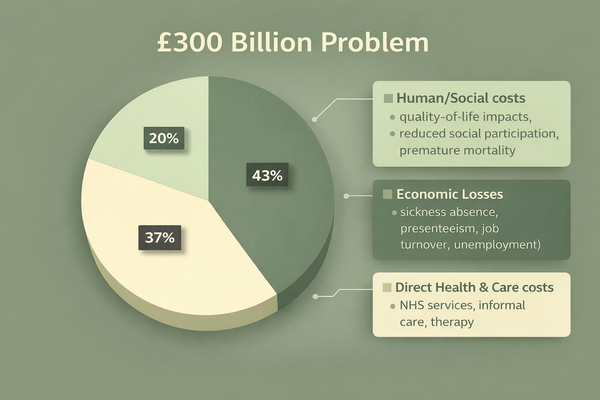
  • In England, total economic and social costs reached around £300 billion in 2022 Centre for Mental Health.
  • Breakdown of Costs: £110 billion in economic losses (sickness absence, presenteeism, job turnover, unemployment) Centre for Mental Health. £130 billion human/social costs (quality‑of‑life impacts, reduced social participation, premature mortality). £60 billion direct health & care costs (NHS services, informal care, therapy) Mental Health Foundation+5Centre for Mental Health+5Centre for Mental Health+5.
  • 1 in 6 children aged 5 to 16 were identified as having a probable mental health condition in 2021. (NHS Digital)
  • 75% of mental health problems are established by age 24. (Mental Health Foundation)
  • 1 in 4 people in the UK will experience a mental health problem each year. (Mind)
  • Only 34% of young people with a mental health disorder get access to the treatment they need. (Children’s Commissioner, 2023)
  • Over 50% of UK teachers report burnout, largely due to unmet student wellbeing needs. (Teacher Tapp, 2022)
  • Schools that implement social-emotional learning programmes see an 11% improvement in academic outcomes. (CASEL, 2020)
  • Children with high emotional intelligence are 54% more likely to report good mental health. (YoungMinds UK)
  • Emotional regulation is a top 3 skill employers want by 2025. (World Economic Forum)
  • 85% of success in life is attributed to soft skills like self-awareness, empathy, and resilience. (Carnegie Institute of Technology)
  • Young people are twice as likely to flourish when taught practical self-awareness and mindfulness techniques. (NICE Guidelines, 2022)
  • Life skills education can reduce future unemployment risk by up to 40%. (OECD, 2021)
  • 93% of headteachers say pupils’ mental wellbeing has been negatively affected by external stressors and social media. (NAHT, 2023)
  • Only 30% of UK schools offer a consistent wellbeing curriculum. (Department for Education Internal Survey)
  • 66% of schools say they lack training and resources to deliver holistic wellbeing education. (Education Support, 2022)Schools that implement social-emotional learning programmes see an 11% improvement in academic outcomes. (CASEL, 2020)

Disclaimer:  This website can’t provide immediate or crisis support.


Shout (24/7 text support) Text “SHOUT” to 85258 | Free, confidential support by text, 24 hours a day.

Samaritans (24/7 call support) Call 116 123 | For anyone struggling to cope, day or night.

Hub of Hope (local support finder) Search for mental health services and charities near you.

NHS urgent mental health support Call NHS 111 and choose option 2 to reach your local urgent mental health helpline.


Immediate danger: If you’re in immediate danger or can’t keep yourself safe, call 999 or go to your nearest A&E.